Why It Matters – R70
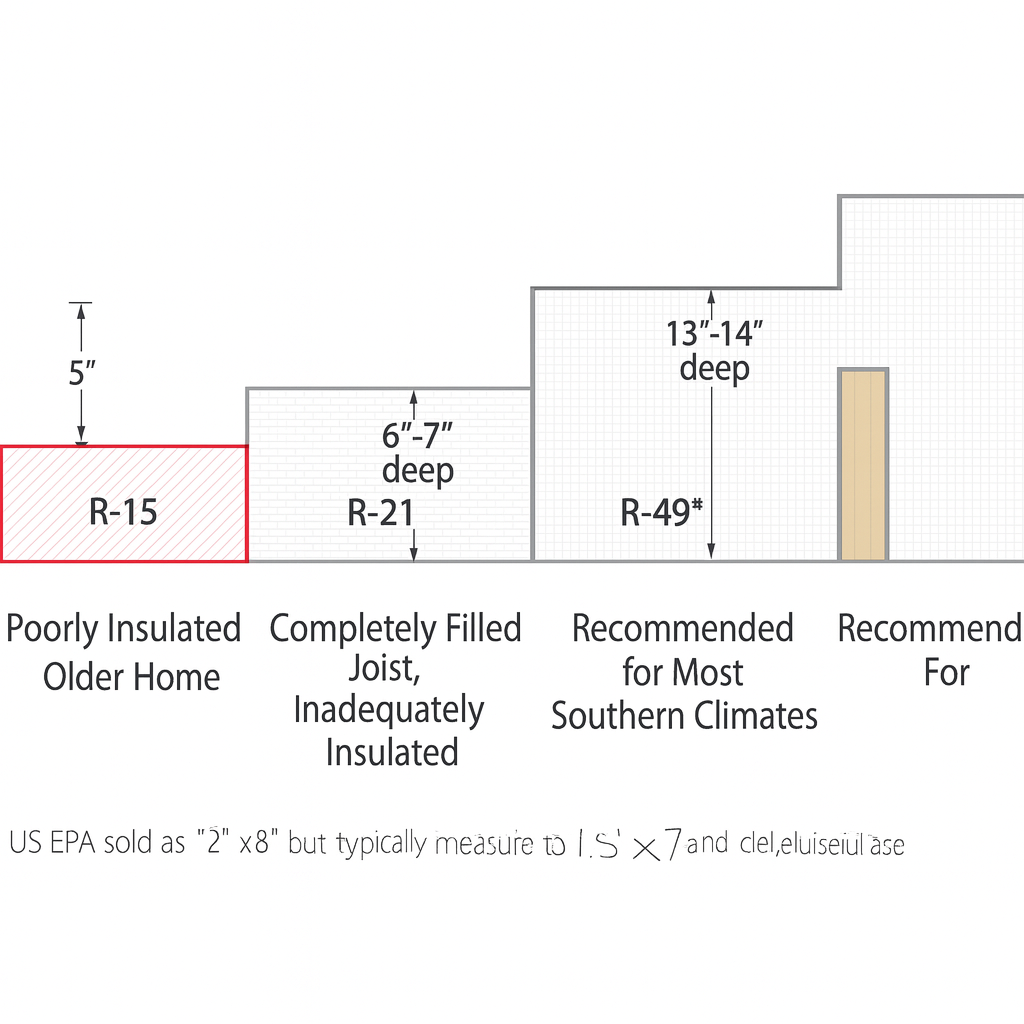
If you’re among the 90% of U.S. homes that are under-insulated (Under R49), your attic might be costing you more than you think.
Proper insulation helps:
- Lower energy bills*
Maintain indoor comfort year-round
Reduce wear and tear on HVAC Conditioning System
Step 1: Inspect Your Attic Insulation
Go up into the attic
Check the insulation’s condition
Measure its depth and identify the type
 Insulation levels are measured by R-value (thermal resistance). The higher the R-value, the better the insulation’s effectiveness.
Find a Insulation Contractor Near You
Assessing What You Have
| What You See | Likely Material | R-Value = Depth × |
|---|---|---|
| Loose yellow, pink, or white fibers | Fiberglass (loose-fill) | 2.5 |
| Dense gray/white with black specs | Rock wool | 2.8 |
| Small gray flat pieces (newsprint-like) | Cellulose | 3.7 |
| Lightweight granules | Vermiculite or Perlite | 2.7 |
| Rolled batts (pink, yellow, white) | Fiberglass (batts) | 3.2 |
 Chart courtesy of Energy Star
Step 2: Determine How Much Insulation You Need
Influencing Factors:
Location – Cold climates require higher R-values than warmer climates, but both need proper insulation to resist heat flow and maintain comfortable indoor temperatures year-round. In colder months, insulation slows the escape of heat from inside a building, while in warmer months, it slows the transfer of heat from outside to inside.
Age of Home – Homes over 10 years old often need an insulation upgrade to at least R60 or preferably R70
U.S. Climate Zone Map & Insulation Recommendations
Below is the U.S. Department of Energy Climate Zone Map, which guides how much insulation is ideal for your region.
Recommended Attic Insulation by Climate Zone
Climate Zone Map:
Recommended Attic R-values by Zone
| Climate Zone | Example States | Recommended Attic R-Value |
|---|---|---|
| Zone 1 | Southern Florida | R30 – R49 |
| Zone 2 | Southern Texas, Coastal California | R30 – R60 |
| Zone 3 | Georgia, South Carolina | R30 – R60 |
| Zone 4 | Virginia, Oklahoma | R38 – R60 |
| Zone 5 | Northern Illinois, Pennsylvania | R49 – R60 |
| Zone 6 | Upstate New York, Michigan | R49 – R60 |
| Zone 7 | Northern Minnesota | R49 – R60 |
| Zone 8 | Arctic Alaska | R49 – R60 |
 Use higher values in colder zones or older homes for better energy efficiency.
Quick DIY Tips:
Seal air leaks before adding insulation
Avoid blocking soffit vents
Use insulation rulers for depth accuracy
Summary: Is It Time to Upgrade?
| Task | Status |
|---|---|
| Checked attic insulation depth |  |
| Identified insulation type | |
| Found your climate zone | |
| Compared with DOE recommended R-value | |
| Planned your insulation upgrade | |